OMA 2026 Social Media Ambassador Blog -Mel Magin
The Ohio Museums Association knows a conference isn't just about sessions and speakers, it's about making connections, sharing ideas, and sparking conversations. To help us do all of those things at our annual conference, OMA was proud to once again host a Social Media Ambassador for OMA2026.
Their vibrant museum voice helped us create a robust online presence during OMA2026 - both for folks joining us in-person in Columbus, and for those not able to attend but following along on their favorite social media sites.
With their unique experience as our online correspondant, we wanted to hear from our Social Media Ambassador about the OMA conference from their perspective.
Below, we continue our 2026 Conference Blog Series as Social Media Ambassador Mel Magin shares their 2026 conference experience. Mel is in their Senior year at The Ohio State University.
 Restoration
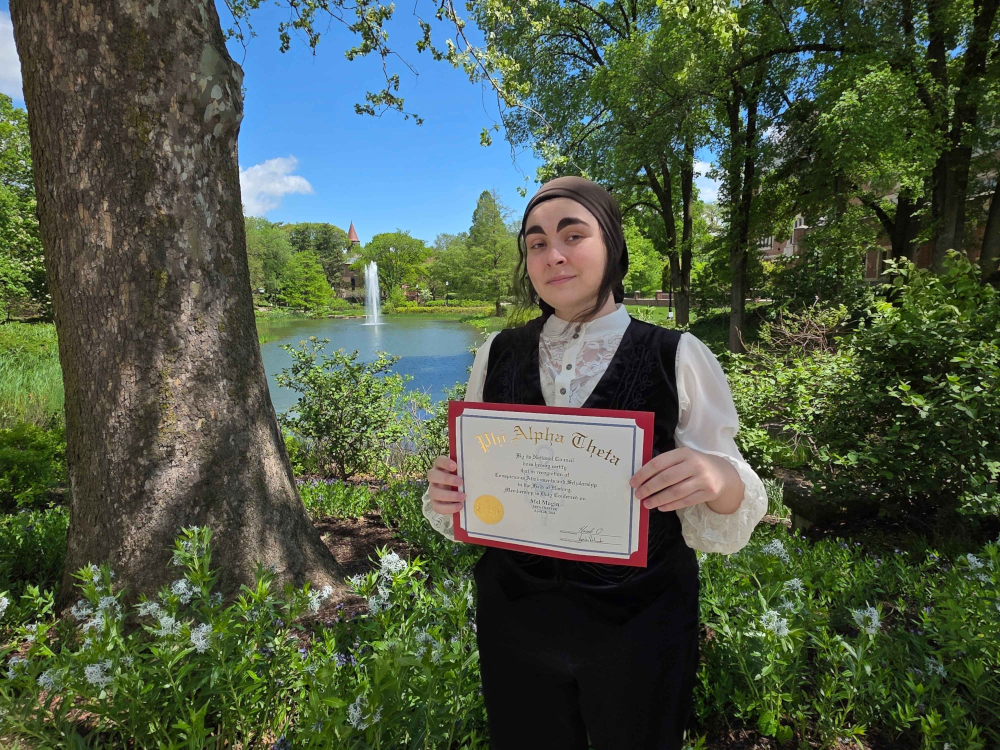
Hello, my name is Mel Magin. I am a History and Political Science major, and a recent inductee into the Phi Alpha Theta Honors Society, in my senior year at The Ohio State University. I am also a historical reenactment hobbyist for the Society for Creative Anachronism, and a former career historical Interpreter. This year at the 2026 OMA annual conference held in Columbus, I was the conference's sole Social Media Ambassador.
About this time last year, when we all visited Athens for the 2025 annual conference, there was a lot of uncertainty, to say the least. And I remember that during that conference, the 2 most impactful takeaways I had from that experience came from the Ridges, the building that loomed over our hotel and that represented a rather uncomfortable truth. The Ridges was something you noticed, almost immediately, but in some ways it felt like the reality of what that building used to be was actively being suppressed in favor of something more palatable. I remember hearing it likened to a Cadillac rotting in a ditch, both because many of the complex' buildings were in disrepair due to weather and time and not really maintained, but also due to people not wanting to confront the history of that building for everything it was and wasn't. It all felt very symbolic since that is also a pretty accurate encapsulation of Appalachia as a whole as well as what it felt like to be a young museum professional about to graduate into a field that felt like it was actively collapsing around me as I was just stepping into it. The importance of the history, that of the Ridges, that of South East Ohio and other areas of Appalachia, that of our very field itself, felt like it was slowly slipping into that ditch. And to be candid leaving that conference that metaphorical weight hung quite heavy on me as I looked towards an uncertain future. But a year has passed since then and we are now in Columbus, Ohio's capital.
Going into OMA 2026, that Cadillac metaphor originally used to describe the Ridges kept popping up in my head a lot. But unlike the ridges, where that metaphor served as a way to describe the current state of the slowly rotting buildings, I did not feel like I was just staring at that Cadillac actively sitting in a ditch. I felt like I was actively watching it be hoisted from the ditch and slowly restored. And this feeling was particularly encapsulated by the Saturday and Sunday Evening tours. While my family is from the hills of the South East, I also call Columbus my home since I have also spent a very large portion of my time here. I grew up going to places the Columbus Museum of Art, which is where I spent some time volunteering as a teenager, Cosi, which is where we would burn entire days engaging in activities like their old Adventure! exhibit or playing around in their old space exhibit. and the Conservatory where I used to go to look at butterflies and Dale Chihuly's glass sculptures. I also used to work at Ohio History Connection for Ohio Village where I designed my own program, taught people of all ages about Ohio's Victorian History, and even wrote some of my own programming. We did go visit all those places and I relived a lot of memories. But we also visited Poindexter Village, one of the very first Public Housing projects in the US and the first to specifically serve black communities, along with the Rickenbacker House, home of famed Pilot and Medal of Honor winner Eddie Rickenbacker. Both of those projects were in different states of repair and restoration. Both of those projects were far more than just institutions that existed to fill a niche, they were being spearheaded by people who genuinely cared and were invested in what they represented. And of these projects being able to survive and thrive, even through times of uncertainty, made me feel much better about times to come for our industry.
One of the things I really enjoy about the OMA conference, both from a social media perspective and as a person, is all the different places we get to tour and stories we get to experience. Outside of being some great photo opportunities (which was particularly true for the Columbus Museum of Art and Franklin Park Conservatory), they are all places with stories of their own that we get to experience glimpses of, even if briefly. And not all of these museums are large either, a lot of them are places, even as a Columbus Native, I had no idea existed or would be within my scope of knowledge if I did not know where to look. Each one of those places have a story of their own, a Cadillac they dug out of a ditch and now proudly display for all to see, or a Cadillac slowly being pieced back together after almost being forgotten. It is a privilege to hear those stories, but it is a duty of ours to spread them and to value them for all they are, and all they are not, and all the work that it took getting them here. And being able to go on tours in my own city, learn things that are new, and be able to share those things to people is a huge privilege, especially when you get to see things early on before they are fully realized. Because our communities need history and people to tell it. They need people who want to fix the Cadillacs of the world, historical sites big and small, known and unknown. They need us to make these histories available and accessible to them. And they need us to care just as much as we need them to. And each and every time I go on this conference, meet more people who are in service of that dream and of restoring and maintaining history, that proverbial Cadillac, the grow a greater appreciation for all of it. You do not always get that level of impact through a screen or through just reading about it. You get it through touching it, physically being in it, hearing it with your own ears and eyes. And these tours we did provided a very hands-on way to do that, especially by showing us the behind-the-scenes of just what it takes to restore a project, just what it takes to run and be involved with something, and connect us with the people who are the movers and shakers. Its envaluble.